Quick Answer: No, jaggery is not a safe sugar replacement for diabetics. Despite being less processed and containing more minerals than white sugar, jaggery has a glycemic index of 84.4 (compared to sugar’s 65) and raises blood sugar just as fast — sometimes faster. Diabetics should limit jaggery the same way they limit sugar. Below, we explain the full science, what studies show, and what doctors actually recommend.
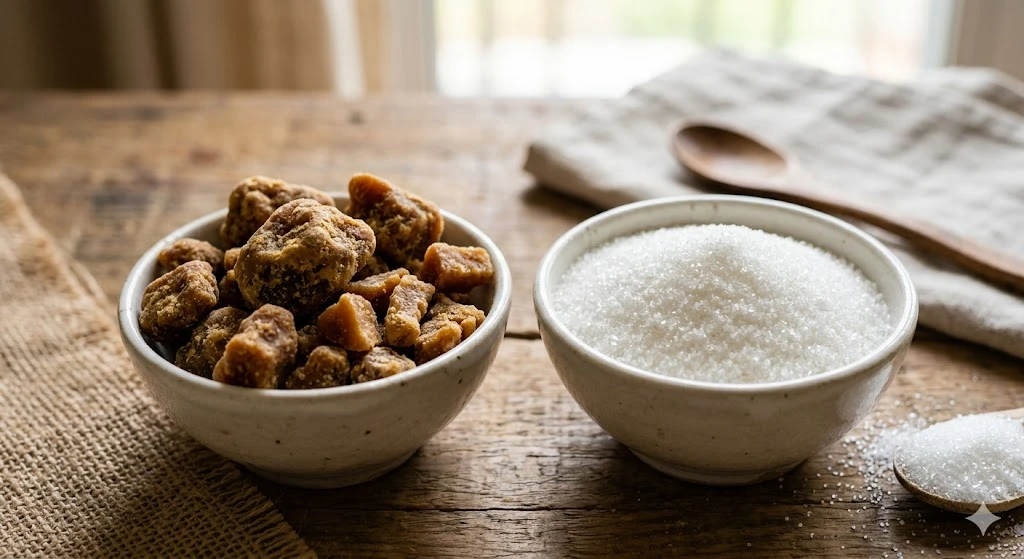
This is one of the most common health misconceptions in Indian households. Many families believe that because jaggery (gur) is “natural” and “unprocessed,” it’s somehow safe for people with diabetes. Social media has amplified this belief, with countless posts claiming jaggery is a “healthy alternative to sugar.”
The reality is more nuanced — and getting it wrong can be dangerous for anyone managing diabetes. In this guide, we’ll break down the actual science, compare the glycemic impact of jaggery vs sugar with real data, and give you a clear, evidence-based answer.
‘When my relative was diagnosed with type 2 diabetes, the first thing my aunt said: Switch to gur, it’s natural, and it won’t raise your sugar. They believed it until the doctor saw post-meal glucose numbers. That’s what prompted me to research this thoroughly.
What Is Jaggery (Gur)?
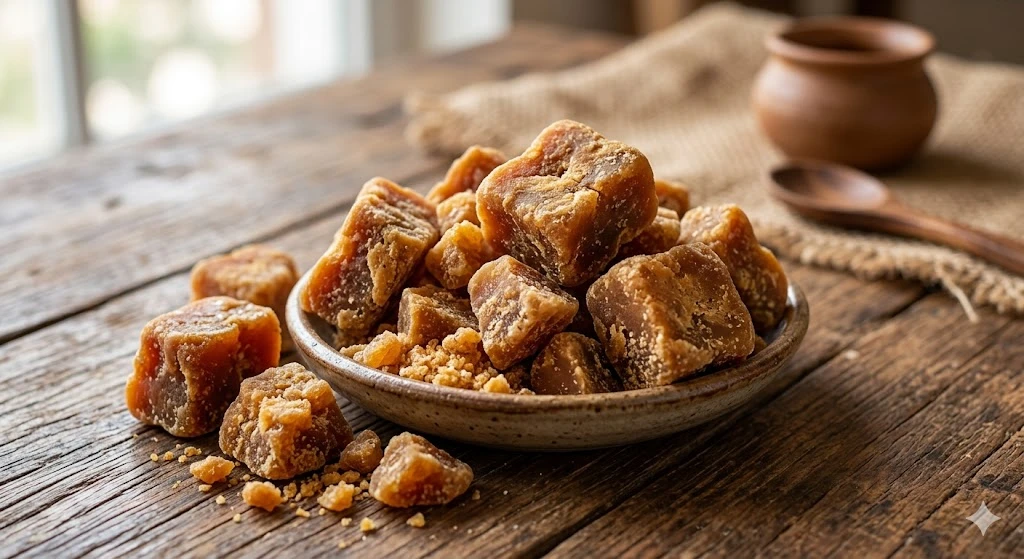
Jaggery is an unrefined sweetener made by boiling raw sugarcane juice (or sometimes palm sap) until it solidifies. Unlike white sugar, which undergoes extensive processing, bleaching, and chemical treatment, jaggery retains some of the minerals and plant compounds from the original sugarcane.
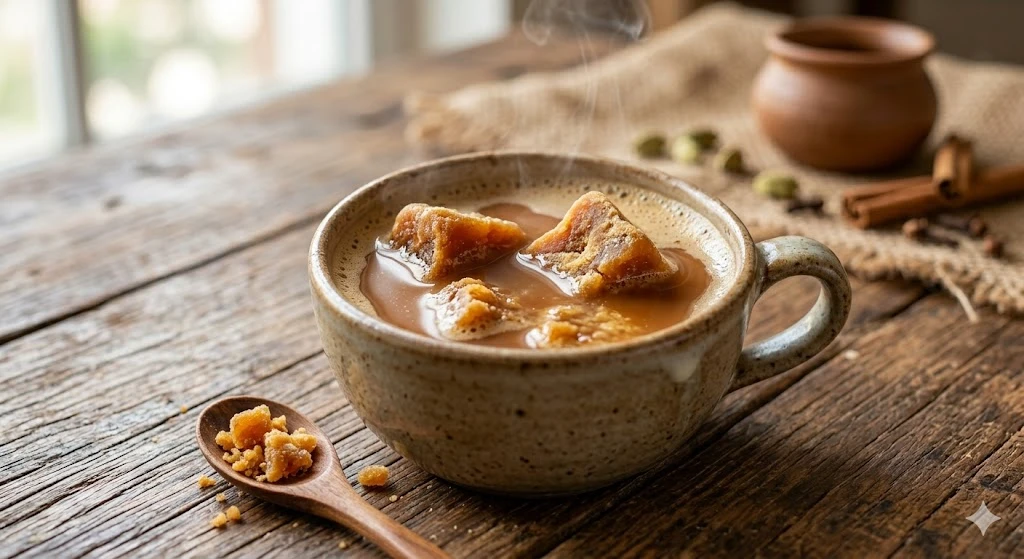
It’s a staple in Indian, Southeast Asian, and African cuisines, used in everything from desserts to chai. The golden-brown blocks and powder are available in Indian grocery stores worldwide and increasingly in US stores like Whole Foods and on Amazon.
Because it’s less processed, many people assume it’s healthier. And for non-diabetics, jaggery does have some nutritional advantages over white sugar. But for diabetics, the picture is very different.
Jaggery vs White Sugar vs Honey: The Nutrition Comparison
| Nutrient (per 100g) | Jaggery (Gur) | White Sugar | Honey |
| Calories | 383 | 387 | 304 |
| Sucrose/Sugar content | 65–85% | 99.9% | 82% (fructose + glucose) |
| Glycemic Index (GI) | 84.4 | 65 | 58 |
| Iron | 11mg (61% DV) | 0.01mg | 0.4mg |
| Potassium | 1050mg (22% DV) | 2mg | 52mg |
| Magnesium | 70–90mg | 0mg | 2mg |
| Calcium | 40–80mg | 1mg | 6mg |
| Processing level | Minimal (boiled only) | Heavily processed | Minimal |
| Fiber | 0g | 0g | 0g |
Here’s the critical number in that table: the glycemic index. Jaggery’s GI of 84.4 is actually HIGHER than white sugar’s GI of 65. This means jaggery raises your blood sugar faster and more sharply than the same amount of white sugar.
Yes, jaggery has more iron, potassium, and magnesium. But those minerals don’t offset the blood sugar spike. You can get those same minerals from vegetables, nuts, and legumes without any impact on blood glucose.
Why Jaggery Is NOT Safe for Diabetics (The Science)
1. The Glycemic Index Problem
A food’s glycemic index measures how quickly it raises blood sugar on a scale of 0–100. Foods above 70 are considered “high GI.” Jaggery’s GI of 84.4 puts it firmly in the high-GI category — even higher than white table sugar (65). This means eating jaggery causes a rapid, steep blood sugar spike, which is exactly what diabetics need to avoid.
A study published in the Journal of Food Science and Technology measured the glycemic response of jaggery in human subjects and confirmed that it produces a blood glucose spike comparable to or greater than an equivalent amount of sucrose.
2. Sucrose Content Is Still Very High
Jaggery is 65–85% sucrose by weight. Sucrose is the exact same molecule whether it comes from jaggery, white sugar, brown sugar, or coconut sugar. Your pancreas doesn’t care whether the sucrose arrived in a “natural” package or a processed one — it still has to produce insulin to handle it, and for diabetics, that system is already impaired.
3. The “Healthy Minerals” Argument Falls Apart
Yes, jaggery contains iron, potassium, and magnesium. But let’s put this in perspective: to get a meaningful amount of iron from jaggery, you’d need to eat roughly 40–50 grams daily. That’s 150–190 extra calories of pure sugar. A single cup of cooked spinach provides the same iron with almost zero impact on blood sugar. The minerals in jaggery are a nutritional bonus for healthy people, not a reason for diabetics to consume it.
4. The “Slow Digestion” Myth
Some websites claim that jaggery is digested more slowly than sugar because it’s less processed. This is not supported by evidence. The glycemic index data — which directly measures how fast blood sugar rises after eating a food — shows that jaggery is actually absorbed FASTER than white sugar. The minimal amounts of fiber-like compounds in jaggery are not enough to meaningfully slow digestion.
But My Family Has Been Eating Jaggery for Generations…
This is the most common pushback, and it’s completely valid. Here’s the important context:
Generational health was different. Our grandparents walked 5–10 miles daily, ate much smaller portions, and consumed far less total sugar. They could metabolize small amounts of jaggery because their overall carbohydrate load was much lower and their insulin sensitivity was much higher. Modern lifestyles involve far less physical activity and far more total sugar consumption.
Portion sizes have changed dramatically. Traditionally, jaggery was consumed in tiny amounts — a small piece after a meal, maybe 5–10 grams. Today, people use jaggery liberally in chai, desserts, and cooking, often consuming 30–50+ grams daily without realizing it.
Diabetes wasn’t as prevalent. India now has over 100 million people with diabetes — the second-highest number in the world. The metabolic landscape has changed. What worked for previous generations doesn’t necessarily work for a population dealing with widespread insulin resistance.
‘My grandmother used to eat a small piece of gur after lunch every day and lived to 92 with no diabetes. But she also walked 3 miles to the market and back, ate mostly dal-roti-sabzi, and her total daily sugar intake was probably under 15 grams. My father, who drives to work and eats much more processed food, developed diabetes at 55. Same family, very different metabolic realities.
How Much Jaggery Can Diabetics Safely Eat?
The honest answer: as little as possible. If you have diabetes, the safest approach is to treat jaggery the same way you treat sugar — as something to minimize, not substitute.
However, if you absolutely must use a sweetener and prefer jaggery for its taste, here are some guidelines:
Maximum: 5–10 grams per day (about 1–2 teaspoons). This small amount will have a minimal blood sugar impact for most people. But even this should be accounted for in your total daily carbohydrate intake.
Always pair with protein, fat, or fiber. If you eat a small piece of jaggery, have it alongside nuts, seeds, or a protein-rich meal. The fat, protein, and fiber slow down sugar absorption, reducing the spike.
Never eat jaggery on an empty stomach. The GI impact is worst when consumed alone without other foods to buffer absorption.
Monitor with a glucose meter. The only way to know YOUR personal response is to test. Eat a measured amount of jaggery and check your blood sugar at 1 hour and 2 hours after. If it spikes above 180 mg/dL, that amount is too much for you.
Better Sweetener Alternatives for Diabetics
| Sweetener | GI | Calories (per tsp) | Blood Sugar Impact | Taste |
| Stevia | 0 | 0 | None | Sweet with slight aftertaste |
| Monk fruit | 0 | 0 | None | Clean sweetness, no aftertaste |
| Erythritol | 0 | 0.2 | Negligible | Cool, clean sweetness |
| Xylitol | 7 | 10 | Very low | Similar to sugar |
| Coconut sugar | 54 | 15 | Moderate (still raises sugar) | Caramel-like, similar to jaggery |
| Jaggery | 84.4 | 15 | HIGH — spikes fast | Rich, earthy, molasses-like |
| White sugar | 65 | 16 | High | Pure sweetness |
Best options for diabetics: Stevia and monk fruit are the safest choices for diabetics because they have zero glycemic impact. They’re now widely available at Walmart, Target, and Amazon. Many Indian families are making the switch for chai and cooking.
If you want something closer to jaggery’s taste: Coconut sugar has a similar earthy, caramel-like flavor with a lower (but not zero) glycemic index. It’s a better option than jaggery but still needs to be limited. Monk fruit brown sugar blends are another option that mimics the taste.
‘We switched to stevia drops in our chai last year. Honestly, it took a few days to get used to, but now nobody in the family can tell the difference. My dad’s post-meal sugar readings dropped by 30–40 points just from that one change.’
Also read: Haldi Doodh (Turmeric Milk) for Joint Pain: Recipe, Benefits & How It Works
What Do Doctors and Nutritionists Actually Say?
The medical consensus is clear and consistent:
American Diabetes Association (ADA): Does not recommend any form of added sugar, including natural sweeteners like jaggery, honey, or maple syrup, for people with diabetes. All added sugars should be minimized.
Indian Council of Medical Research (ICMR): Specifically advises diabetics against using jaggery as a sugar substitute, noting that its high glycemic index makes it unsuitable for blood sugar management.
Registered Dietitians: Consistently recommend that diabetics focus on reducing total sweetener intake rather than switching between types of sugar. The idea of a “safe” sugar for diabetics is a misconception.
The general medical advice is straightforward: if you have diabetes, reduce ALL concentrated sweeteners — whether white sugar, jaggery, honey, or maple syrup. Replace them with zero-calorie alternatives like stevia or monk fruit when you need sweetness.
Also read: Kadha Recipe for Cold and Cough: 5 Ayurvedic Immunity Drinks You Can Make at Home
Common Myths About Jaggery and Diabetes (Debunked)
Myth: “Jaggery doesn’t raise blood sugar because it’s natural.”
False. Jaggery has a glycemic index of 84.4 — higher than white sugar. “Natural” does not mean “safe for diabetics.” Sugarcane itself is natural, and that’s where all sugar comes from.
Myth: “Jaggery is slowly digested, so the sugar is released gradually.”
False. The glycemic index directly measures this, and jaggery scores higher than white sugar, meaning it’s absorbed FASTER, not slower.
Myth: “The minerals in jaggery help your body process the sugar.”
Misleading. While jaggery does contain iron and potassium, these minerals do not change how your pancreas handles the sucrose. There is no clinical evidence that the mineral content of jaggery reduces its glycemic impact.
Myth: “Replacing sugar with jaggery in chai cured my neighbor’s diabetes.”
Anecdotal and almost certainly inaccurate. Diabetes management involves medication, diet, exercise, and weight management. No single food swap “cures” diabetes. If someone’s blood sugar improved after switching to jaggery, other factors (diet changes, increased exercise, medication adjustment) were likely responsible.
Myth: “Organic/palm jaggery is safer for diabetics than regular jaggery.”
False. Palm jaggery and organic jaggery have similar sucrose content and glycemic impact to regular sugarcane jaggery. The source of the jaggery doesn’t change its sugar content.
Also read: 22 Home Remedies for Blocked Nose | Sore Throat | Stuffy Nose
Frequently Asked Questions
Can pre-diabetics eat jaggery?
Pre-diabetics should also limit jaggery. The goal for pre-diabetics is to prevent progression to type 2 diabetes, which means keeping blood sugar spikes to a minimum. Small amounts (5g or less) occasionally are unlikely to cause harm, but jaggery should not be a daily habit.
Is jaggery better than sugar for non-diabetics?
For people without diabetes or insulin resistance, jaggery is a slightly better choice than white sugar because of its mineral content. But “slightly better” doesn’t mean “healthy.” It’s still concentrated sugar and should be consumed in moderation by everyone.
Can I use jaggery powder instead of blocks? Is it safer?
Jaggery powder and jaggery blocks have the same nutritional profile and the same glycemic impact. The form doesn’t matter — the sugar content is identical. Some jaggery powders may even have added white sugar, so check the label.
What about jaggery in Ayurvedic medicine?
Traditional Ayurveda does use jaggery medicinally in certain formulations, typically in very small amounts as a carrier for herbal medicines. This is very different from eating jaggery as a daily sweetener. The medicinal use involves tiny doses (1–3 grams) with specific therapeutic herbs, not tablespoon-sized portions in tea.
My blood sugar is well-controlled with medication. Can I eat jaggery then?
Even with medication, unnecessary blood sugar spikes put stress on your system and can contribute to long-term complications. Well-controlled diabetes means keeping blood sugar as stable as possible, not spiking it and relying on medication to bring it back down. Talk to your doctor about what sweeteners work best with your specific treatment plan.
Can I use jaggery in cooking (not eating it raw)?
Cooking does not change jaggery’s glycemic index or sugar content. Whether you eat it raw, dissolved in tea, or cooked into a recipe, the same amount of sucrose enters your bloodstream. The only advantage of cooking with jaggery in a larger dish is that the serving size of jaggery per portion is usually smaller.
The Bottom Line
Jaggery is not a safe sugar alternative for diabetics. Despite its “natural” reputation and mineral content, it has a higher glycemic index than white sugar and raises blood sugar rapidly. The minerals it provides are easily obtained from vegetables and legumes without any blood sugar impact.
If you have diabetes or pre-diabetes, the best approach is to reduce all concentrated sweeteners and use zero-calorie alternatives like stevia or monk fruit when you need sweetness. If you choose to eat small amounts of jaggery occasionally, keep it under 5–10 grams, pair it with protein or fat, and monitor your blood sugar response.
Love the taste of gur in your chai? Try monk fruit sweetener drops — several brands now make options specifically designed to mimic the earthy sweetness of jaggery without any blood sugar impact.
‘This was a hard article to write because I grew up believing jaggery was a healthy food and for healthy people, it is — in small amounts. But watching my father’s blood sugar spike after his evening chai with gur was the wake-up call our family needed. We switched to stevia last year, and his numbers have been noticeably better. Sometimes the hardest part of managing diabetes is letting go of food traditions that don’t serve us anymore.’
Medical Disclaimer: This article is for informational purposes only and does not constitute medical advice. Always consult your healthcare provider or a registered dietitian before making changes to your diet, especially if you have diabetes or take blood sugar-lowering medication. Never stop prescribed medication based on dietary changes without medical supervision.